
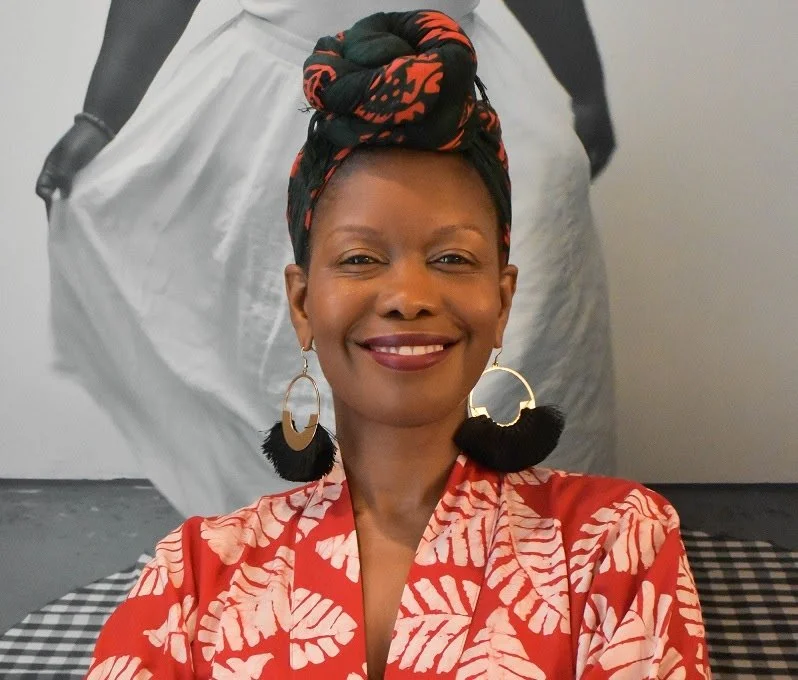
Shanequa Gay
“Gay is a storyteller, born and raised in Georgia, whose work draws on the environment and spiritual symbolism of the American South. Blending motifs from regional life, she explores identity, culture, and power through storytelling, highlighting formidable female figures and intergenerational relationships. Her practice—encompassing installations, paintings, performance, photography, video, and monumental sculptures—challenges dominant narratives, reclaims space through personal memory and mythology, and creates immersive environments that invite reflection on self and belonging.”
“For my work of art, I wanted to add the spice of speculation, Black Femme Fantastic, and the tenets of visual art-making in Afrofuturism such as temporality, transformation, appropriation and fugitivity. ”
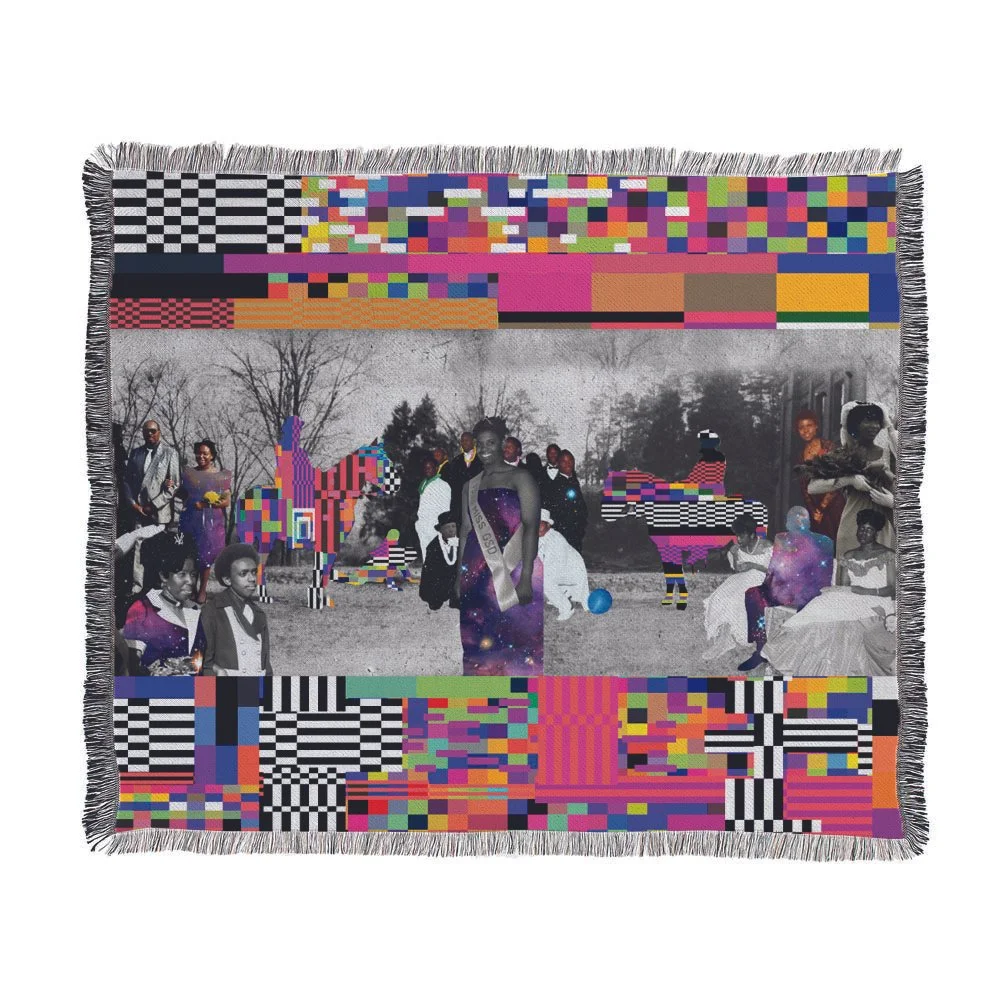
The Black Deaf Futurity Center (2025) by Shanequa Gay
“Speculation always begins with “what if?” I wanted to disturb and drown these dreary portraits with hope, color and a future that reflected the ways Black deaf students navigated their Hyper-marginalized status and environments as a kind of paradise, another world unencumbered by the motion sickness of racism….
….In this world, Black girls have agency: they are being crowned by past queens and teachers, ushered onto the stage by their fathers, brothers and male friends, they are present, in the past and time traveling all at once. In this work the Black and Deaf are the heroes and heroines, the concepts of the Black Femme Fantastic are at the forefront, the Glitch is de-centered, the hypermarginalized are salient and Black girls and young women are venerated and liberated time benders.”
________________________________________
Shanequa Gaye’s colorful textile transforms images of Wesley Olin Connor (1841–1920) into a celebratory landscape of Black achievement. Connor was a member of the Ku Klux Klan who was also Superintendent of the Georgia School for the Deaf, and the racially segregated School for the Colored Deaf in Cave Spring, Georgia. Gaye reimagines three photographs of Connor made from glass negatives located in the nearby case. In her artwork, Connor appears as a background presence through pixelated silhouettes. The geometric shapes that fill Connor’s outlines visualize a digital glitch, a term for a problem that prevents a function from completing as planned. In this case, Connor, as the glitch, has been superseded and marginalized by the well-dressed central figures who thrive despite the odds against them.
Gaye conducted research in the archival collection of the Georgia School for the Deaf and found photographs of homecomings, dances, and proms that document the lively tradition of pageantry organized by Black deaf students. For The Black Deaf Futurity Center, she selected images of these events from the 1980s, an era known for advancements in computer technology and futuristic digital sound. She pays homage to these students’ success through images of the cosmos used to depict the dresses of the women who she calls the “Black femme fantastic.” These colorful references to outer space serve as portals that envision another future away from the earthly limitations of a white supremist ideology held by the school’s former superintendent.
For the form of her artwork, Gaye chose a textile, an intimate domestic object used for warmth, to tell this story of triumph. The colorful patterns along its top and bottom borders recall the weavings of West African kente cloth and quilt tops in the US, two creative textile traditions that have survived for generations, and are treasured by Africans and African Americans.
-Bridget R. Cooks, PhD.
Curator